

Head Home 


Thursday, July 17, 2008

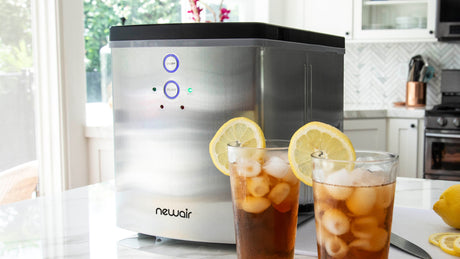
Having a Summer Party? Make Perfect Iced Drinks with the NewAir AI-210SS Portable Icemaker!

Summer's here, and there’s no better time to celebrate the warmer months with cool cocktails in the comfort of your home. Whether you're having an after-work happy hour or a weekend soiree, serving perfectly chilled cocktails will definitely let you toast to a season of fun.

When planning a summer cocktail party, keep in mind that drinks are often the most important focal points. Don’t just serve wine or beer; consider the base of the drinks you’re going to serve, and don’t limit yourself to single spirit drinks. For example, it’s always a good idea to have a rum-based drink, vodka-based drink, and of course, a fruity, frozen summer concoction.

With that in mind, cool drinks require ice, and this is especially important in on-the-rocks beverages, as ice is a major factor in constructing the perfect Tom Collins or Whiskey Sour. The best quality and tasting ice either makes or breaks a great drink, and cubes should be shaped in such a way that it does not take up much surface area because this prevents the drink from “watering down.”

Therefore, if you’re throwing a summer cocktail party, don’t forget to have ample amounts of ice. While your refrigerator’s icemaker can provide enough ice for a few glasses of water or ice tea, you may have to seek other methods of obtaining larger amounts of ice. Many people purchase ice from the supermarket or even from ice companies. These companies use state-of-the-art ice making equipment with a reverse-osmosis purification process, and the resulting ice is bagged and made available to customers.

This type of ice most often comes in the form of dry ice, glacier block ice, and cubed ice. Dry ice is carbon dioxide in a frozen state and is ideal for keeping perishables frozen for long periods of time. Because dry ice doesn’t melt into water but turns into a gas, they are not used directly in beverages. Glacier block ice comes in large blocks and perfect for camping on ice chests. Cubed ice, on the other hand, is what most people use in their drinks, and these can be purchased in various sized bags and quantities.

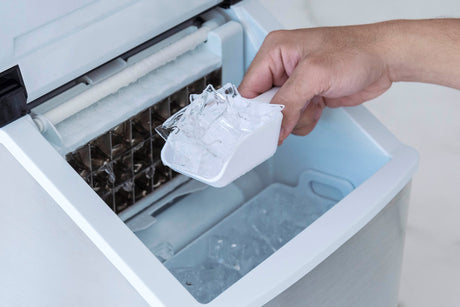
However, if you don’t want to deal with the issue of buying cubed ice from an ice company, a portable ice maker may be just the solution. These types of units are compact, good for countertop placement, and usually produce ice in minutes without needing to be directly connected to a water line. Instead, bottled or tap water can be poured directly into the icemaker. Furthermore, many portable ice makers can produce ice in different sizes and cube shapes.

Our product team has spent the majority of the summer months testing and reviewing some of the most popular portable ice makers on the market today. Well-known icemaker manufacturers include Franklin Chef, Amcor, Avanti, and Sunpentown, but when NewAir, a company primarily known for its air conditioners and heaters, offered to supply us with their NewAir AI-210SS portable ice maker to try, we were excited to see how it measured up in terms of features when compared to competing units. Here’s what we found:

Design:
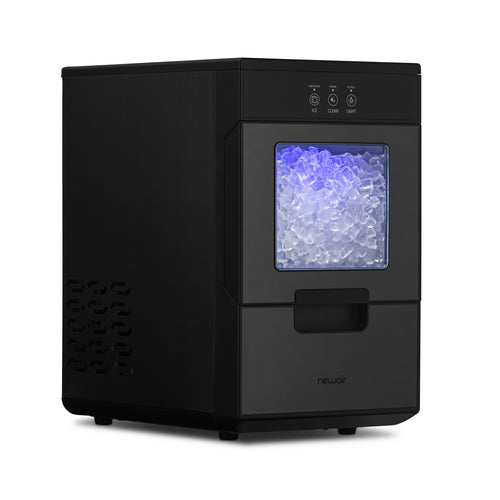
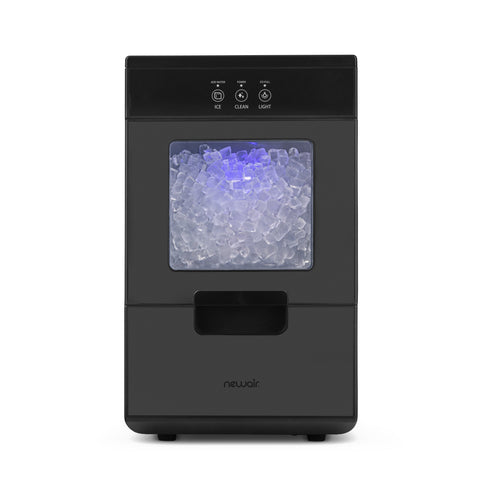
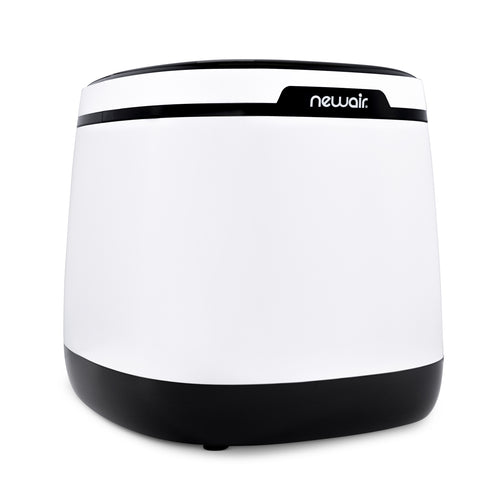
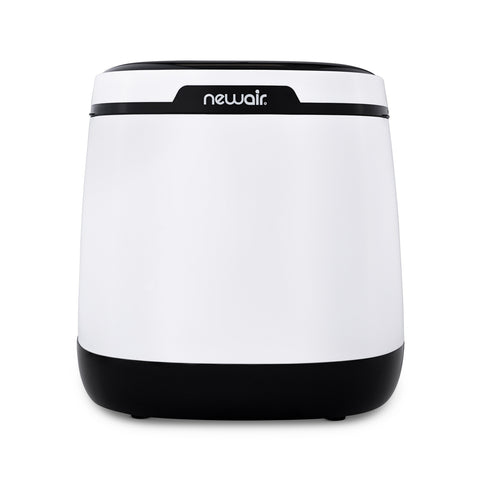
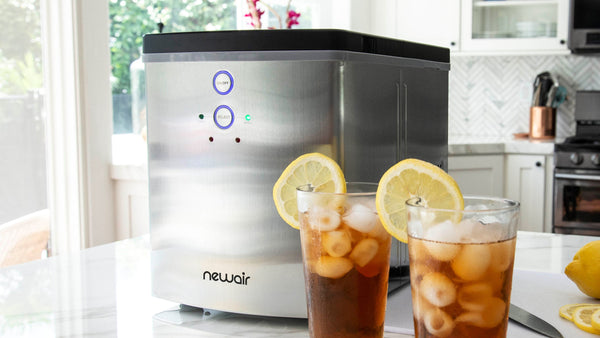
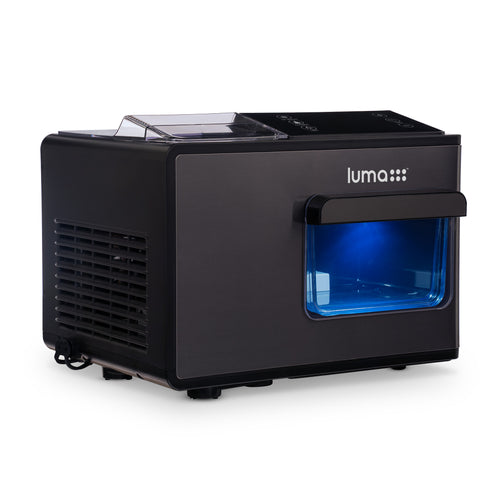
When we received the AI-210SS icemaker, we really liked its sleek and stylish design. It featured a silver body with black accents that looked great sitting on our kitchen counter. Although it weighed approximately 46 pounds, we could tell it was constructed of heavy duty materials and built to last. This 115 volt icemaker easily plugged into a household outlet, and the front door was easy to open and close. Also included was a removable bin and ice scoop. The LCD screen was bright and easy to read, and we were able to have the unit up and running after just a few minutes. We also appreciated the fact that it even had a “Self-Clean” function.

Ice Making Capabilities:
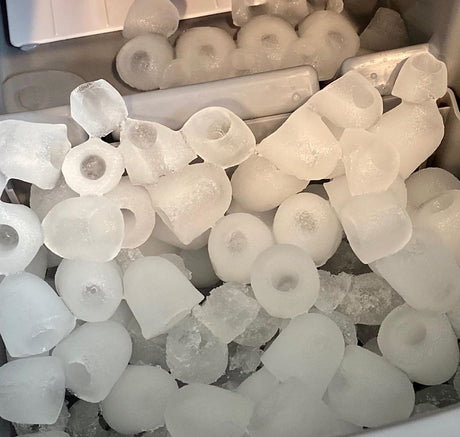
According to NewAir, the AI-210SS portable ice maker produces ice in as little as six minutes, and we found this to be true. Twelve pieces of ice per cycle were made in our choice of three different sizes (small, medium, and large), and instead of having to deal with a water line, we simply poured bottled water into the reservoir. In terms of maintenance, when we were done using the AI-210SS, we simply emptied the unused water via the side mounted drain.

Overall Thoughts:
Overall, we feel the NewAir AI-210SS is the best choice for homeowners that need a compact ice maker. It makes a large amount of ice in a short amount of time and is actually more affordable than other units with similar ice making abilities.

Labels: ,


Digg Del.icio.us Technorati
Furl Reddit Spurl


Friday, July 11, 2008

Get Ice in Minutes with the Sleek and Stylish NewAir AI-200SS Portable Ice Maker!


Summer is already here, and besides sitting in an air conditioned room or in front of a fan at full blast, blistering days are usually tamed by icy chilled drinks. Our refrigerator ice makers can be one of our best friends in the sweltering summer, but like many home appliances, freezer ice makers are prone to malfunctions. Problems can arise from plugged water filters, kinks in the water line, or even expanding/contracting coils, and when such issues occur, we’re usually forced to run to the supermarket to fetch heavy bags of ice. This scenario is especially frustrating during a party or gathering. Thankfully, home ice makers can solve this problem.

Most restaurants use huge commercial-sized ice makers that produce hundreds of pounds of ice per day, but this isn't necessary if you simply want to enjoy a cold drink or need to fill an ice cooler. Instead, a portable countertop ice maker can do the job. Portable ice makers are nothing like commercial icemakers because they’re compact, easy to use, and usually don’t require permanent installation or any type of direct line connection. Water is simply poured into the unit’s tank and ice is made within minutes.

With that in mind, there are several different portable icemaker manufacturers on the market today, and some of the most popular brands are Amcor and Franklin Chef. Our product team has been busy testing some of the newest portable icemakers on the market, and we recently came across the NewAir AI-200SS countertop icemaker.

Perfect for home, RV, or boats; and ideal for parties and get-togethers, the NewAir AI-200SS is affordable and boasts a handful of advanced features as well. Here is what we especially liked about this value-priced portable ice maker:

Design and Style:
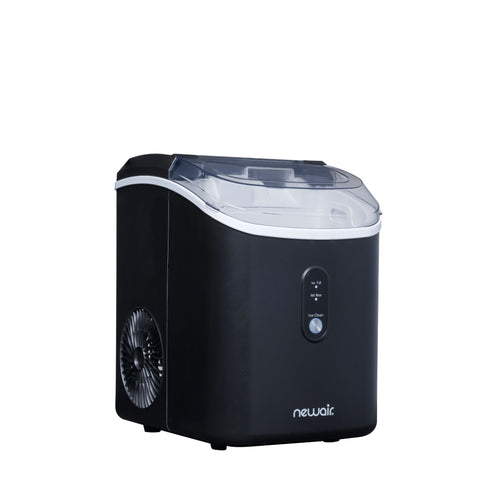
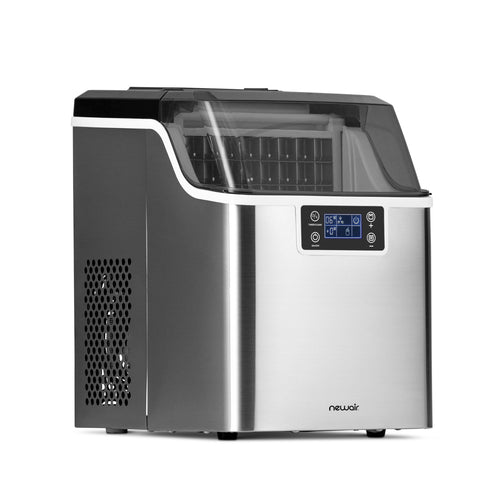
The first thing we noticed about the AI-200SS ice maker was its appearance. Constructed of heavy-duty stainless steel, this unit was sleek, stylish, and looked great in our kitchen. Although it weighed about 46 pounds, its unique cubic shape made it idea for countertop use. We liked the fact that it only required a standard household outlet and did not need to be continually drained or hooked up to a direct water line. Instead, we simply filled the water reservoir with one gallon of bottled water, placed the ice basket back into the unit, and closed the cover. Furthermore, the soft touch controls made the AI-200SS incredibly easy to operate.

Ice Making Abilities:
After filling up the water tank, we were now ready to have a constant and ample supply of ice. Ice was produced in only 10 minutes (12 pieces per cycle), and we were even able to select from three ice cube sizes: large, medium, and small. Each ice making cycle lasted anywhere from 7 to 13 minutes, depending on the ice cube size, and the internal bin was able to hold 2.5 pounds of ice at a time. Over the course of one day, we were able to get approximately 35 pounds of ice from the AI-200SS.

Overall, we really enjoyed the NewAir AI-200SS portable ice maker. In fact, once we began to use it, we wondered how we ever got along without it. Also, at under $250, it was definitely more affordable (and effective) than some of the other models we tested.

Labels: ,


Digg Del.icio.us Technorati
Furl Reddit Spurl


Friday, June 27, 2008

Making Ice Has Never Been Easier with the NewAir AI-100S Portable Ice Maker!

Ice plays an important role in a great cocktail, but is one of the most overlooked ingredients. First and foremost, ice cools down the drink during the mixing process. This process is important because when the temperature of a cocktail is lowered, the taste receptors in the tongue are inhibited. Thus, the drink becomes more palatable and less “alcoholic” tasting. In fact, according to a recent Los Angeles Times article, Christian Frizzell, co-owner of Redwood Bar and Grill in Los Angeles, states, “So long it's all been about mixology or infusion of liquor for flavor. But a perfect pour is not just about adding a bunch of stuff. It's got to be the perfect temperature." Furthermore, ice is such an important subject to bartenders that every year during the Tales of the Cocktail mixologist’s convention, there is a seminar on “The Importance of Ice” which discusses this very subject.

Some bartenders take the issue of ice to the extreme. Many bartenders working in upscale bars in metropolitan cities such as Los Angeles, New York, and Chicago may use bottled or triple distilled artisan water such as Fiji to make their ice, while others make ice in large blocks and hand crack it with a hammer and ice saw. This results in cubes that are larger than crushed ice and perfect for drinks on the rocks.

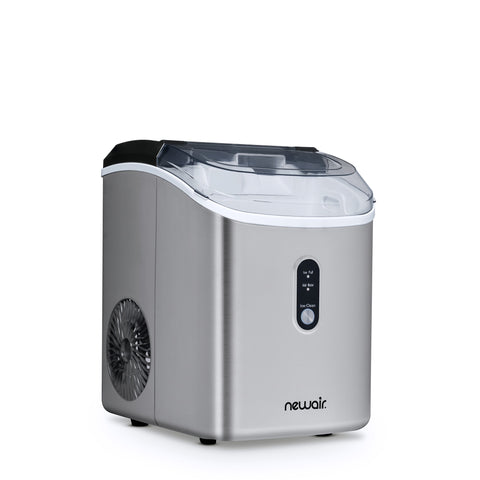
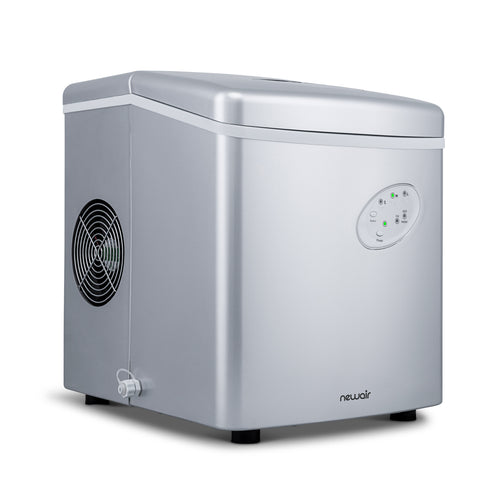
NewAir AI-100S Portable Ice Maker
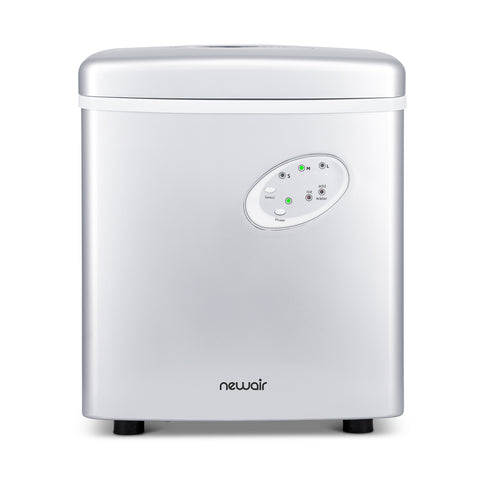
However, if you’re just a casual home bartender, you may not want to resort to hacking away at a huge block of ice with a pick just yet. To ensure great tasting ice (and sufficient amounts of it) at all times, a portable ice maker will do just fine. As such, with summer already here, our product team thought it would be the perfect time to test out some of the finest portable ice makers on the market today. Some of the leading brands we found were Franklin Chef and Sunpentown, but NewAir, a company better known for its line of cooling and heating products, also has a line of excellent home ice makers that are quite affordable.

Whether you use cubed ice, ice nuggets, chopped, or crushed ice, a portable home ice maker such as the NewAir AI-100S is a great choice for the seasoned mixologist or home bartender. Perfect for those who entertain often, this portable icemaker combines style and convenience in one unit. With the ability to produce up to 28 pounds of ice in a 24-hour period, this icemaker ensures that you have a steady ice supply when entertaining large groups of people. For this week, we were fortunate enough to be able to test the NewAir AI-100S compact portable ice maker, and here were our findings:

First Impressions of the AI-100S
When we received the unit, we were amazed at how compact it was. It weighed approximately 34 pounds and featured a sleek silver case that complemented our test kitchen. Furthermore, we appreciated the fact that unlike larger industrial-sized ice makers, the NewAir AI-100S fit nicely on our countertop next to our toaster. The AI-100S connected to a standard household power outlet and best of all, permanent installation was not required. Instead, the unit could be used with either tap or bottled water. In fact, we used Fiji artisan water (just like many top bartenders) in the AI-100S for our Glen Livet on the rocks, and we could definitely taste the difference.

Performance
In terms of ice production, we were impressed that ice was made within 15 minutes of turning the machine on, and we were able to choose from three ice sizes – small, medium, or large, with nine pieces of ice produced per cycle. Also, NewAir claimed this unit could make up to 28 pounds of ice per day, and we did find this to be true. Maintenance was also a breeze: the side mounted drain allowed us to empty the unit directly into the sink, and all we had to do was clean the inside tank with mild soap and water after we were done.

Overall, we really enjoyed using the NewAir AI-100S. At less than $200, it’s definitely more affordable than some of big-name models out there, but offers the same great features and then some.

Labels:


Digg Del.icio.us Technorati
Furl Reddit Spurl


Friday, June 20, 2008

Eliminate Excess Moisture with the NewAir AD-400 Dehumidifier


Dry indoor air can contribute to cracked and warped furniture; dry throat and skin; and static shocks. On the other hand, excess moisture levels can also result in a range of problems. Besides causing discomfort to occupants, excess moisture levels in a building can damage furnishings; promote mildew and mold growth; and even exacerbate asthma, allergy, and other respiratory symptoms. While dry air can be remedied by a simple humidifier or vaporizer, humid air is a bit more complex. There are many indications of excess moisture in the air such as the following:

1. Damp spots on the inner surfaces of exterior walls or even ceilings
2. Mold or mildew growth on ceilings or walls
3. Frost, condensation, or ice on inside window surfaces
4. Frost or ice on the underside of roof sheathing in attic spaces
5. Blistering of paint
6. Sweating water pipes
7. Condensation on basement walls and pipes

The moisture content of the air is often stated in terms of relative humidity, or the amount of moisture the air can hold at that temperature. Thus, if your home has 50% relative humidity, this means that the air is holding half the amount of water it could hold at that temperature. As the given quantity of air is cooled, in turn, the relative humidity of the air will increase. If air is sufficiently cooled, 100 percent relative humidity will be reached and the air will be saturated. Most experts note that indoor humidity levels should ideally be between 40-50%, and to maintain this range, a dehumidifier is the way to go.

When shopping for a dehumidifier, there are a few features to look for, primarily an automatic shut-off function that turns off the unit when the container is full; a signal light that alerts you when the container is full; and even a humidistat that will allow you to set the humidity level to your individual preferences.

That said, with summer already here, those living in both hot and humid climates will definitely need to find a way to address moisture levels, and our product team felt that reviewing a few dehumidifiers would be appropriate. There are several established dehumidifier brands out there, specifically Eva-Dry, Soleus, and Amcor. However, NewAir, a company best known for its selection of portable air conditioners, has just introduced their latest product offering: the NewAir AD-400 dehumidifier. We were lucky enough to test this product in our office, and here’s what we found:

First Impressions:
Other dehumidifiers we’ve seen are generally bulky and unattractive, but the NewAir AD-400 was definitely different. It weighed only 25 pounds, featured a stylish silver body with white accents, and a vertical design that it made it perfect for tight spaces. Heavy-duty rolling casters made it easy to move the unit from room to room, while the carrying handle was also a nice touch. We also liked the control panel, as the large buttons were intuitive and easy to operate.

Dehumidification:
One of the drawbacks found in several portable dehumidifiers is a small capacity water tank. Therefore, assuming the unit can accommodate a direct drainage hose, a dehumidifier with a small tank will need to be continuously drained if you don’t want to be frequently emptying the reservoir. However, we found that the NewAir AD-400 had a dehumidification capacity of 40 pints per day and could be drained continuously. Also, it utilized refrigeration technology – just like an air conditioner – in order to remove excess moisture from the air. Furthermore, the AD-400 included an automatic shut-off function and a full tank indicator.

Built-In Humidistat:
Dehumidifiers with built-in humidistats are great because they allow you to select the desired humidity level for your room, but not every unit has this feature. Thankfully, the NewAir AD-400 had a humidistat for this purpose.

Low Temperature Operation and Automatic Defrost:
In especially low temperatures, a dehumidifier’s tank can freeze over and cycle off. The NewAir AD-400 dehumidifier could operate in rooms where the temperature ranged from 41° F and 53.6° F and it automatically defrosted every 30 minutes.

Air Cleaning:
To address indoor air quality problems, the NewAir AD-400 came equipped with a built-in ionizer for particulates and an activated carbon filter to adsorb odors.

Although some experts may say that all dehumidifiers perform equally, we disagree. Overall, we were definitely impressed with the NewAir AD-400 dehumidifier because of its great features and advanced design.

Labels:


Digg Del.icio.us Technorati
Furl Reddit Spurl


Tuesday, June 17, 2008

NewAir AW-211ED Wine Cooler Combines Form and Function in One Unit!


Most people know two facts about wine: that certain wines must be aged to achieve peak quality and that wine must be stored at the correct manner in order to maintain and fully enjoy its aroma and bouquet. However, few can actually understand the science behind wine aging and thus underestimate the importance of proper storage techniques.

Because wine is a complex balance of amino acids, phenols, carbohydrates, and other chemical compounds, chemical reactions between these compounds can be affected by environmental changes. Seeing as the speed of a chemical reaction increases with temperatures, wine will hardly age if stored at or below 50°F. However, once a bottle of wine is stored at room temperature, years of aging will be accelerated in just months or even weeks. As such, one could say that temperature stability is the mainstay of wine storage.

For the most part, most wines available today are of the “ready-to-drink” variety, but these can be safely stored for a few years by following these conditions:

- Away from sunlight
- At temperatures between 40° F and 65°F, depending on the type of wine
- Humidity levels greater than 50%

If wine is stored outside of these limits, it will be subject to spoilage or premature aging. With that said, proper wine storage is imperative. While the first two of the above conditions can be easily met by the average wine drinker, the last one should be met with some type of cellar, wine cabinet, or wine cooler. Most people don’t have the luxury of building home cellars, so that’s when a wine cooler comes in.

There are many different models and types of wine coolers available, but when choosing one that will best suit your needs, first determine how many bottles you will be chilling at once, then add more capacity to allow for a growing collection. Secondly, figure out what types of wine you will be storing. If you only drink Chardonnay, a wine cooler with a single temperature zone will do. However, if you enjoy both reds and whites, you’ll need a wine refrigerator with at least 2 zones.

With that said, our product team has been busy testing out some of the newest wine coolers on the market today. Some of the best known wine cooler manufacturers are Franklin Chef, Avanti, and Amcor, but there’s another contender on the wine cooler market: NewAir. Primarily known for their line of portable air conditioners, NewAir’s new wine coolers are surprisingly affordable, yet feature several bonuses that you’ll usually find in pricier units. We tested the new NewAir AW-211ED wine cooler and here’s what we thought:

First Impressions:
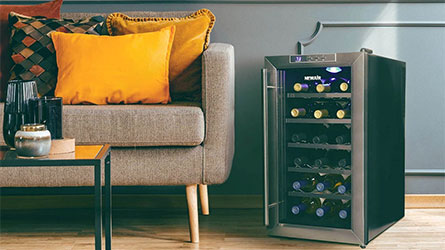
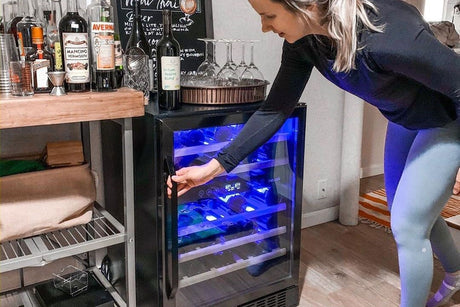
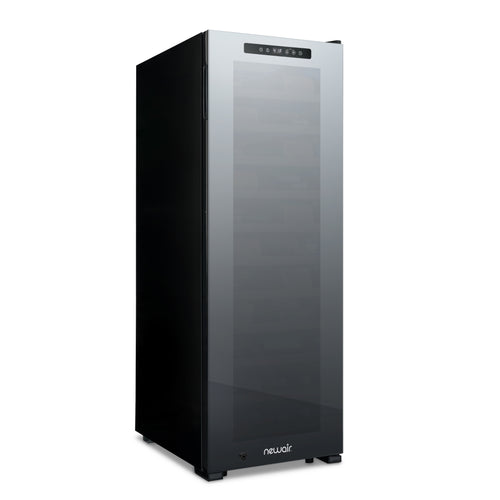
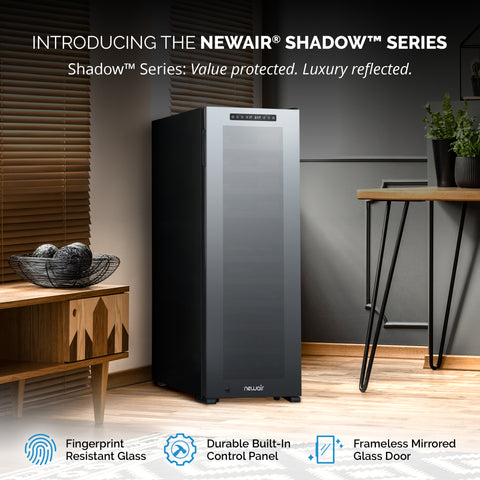
The NewAir AW-211ED was definitely esthetically pleasing and housed in a sleek, black cabinet with stainless steel door. It’s surprisingly compact given its large bottle capacity, and comes with an easy-to-control digital panel with LED light for precise temperature settings. The racks within the cooler are made out of heavy-duty, yet modern-looking chrome, and there was even an internal LED light that increased visibility and provided a nice glow.

Bottle Capacity:
Despite its tower design and space-saving body, the NewAir AW-211ED had a large capacity and was able to hold 21 bottles of our favorite vintages. This was more than enough for us home wine drinkers.

Thermoelectric Technology :
There are generally two types of wine cooling technology out there: compressor and thermoelectric. Compressors seem to be a bit dated, as most people nowadays are looking to thermoelectric coolers. Because thermoelectric wine coolers do not have many moving parts, they do not vibrate and are quiet. Furthermore, because thermoelectric wine coolers such as the NewAir AW-211ED are better at storing and aging wine because they cause less sedimentation that can occur with vibration.

Dual Zone Chambers:
As mentioned, if you’re storing more than one type of wine, you’ll need a wine cooler with at least two temperatures. Dual temperature wine coolers have upper and lower cabinets that are independently refrigerated chambers with separate temperature control capabilities. The NewAir AW-211ED utilized dual zones and allowed us to chill our bottles of Cabernet and Riesling at once.

We were really impressed with the NewAir AW-211ED thermoelectric wine cooler. Not only did it perform as well as advertised, it was also priced at less than $200, making it a steal.

Labels: ,


Digg Del.icio.us Technorati
Furl Reddit Spurl


Friday, June 13, 2008

NewAir AW-210ED Wine Cooler: An Affordable Way to Store Your Wine


Wine can conjure up images of class and elegance, and the key to enjoying wine to its fullest is proper wine etiquette. Whether it’s the temperature of the wine, age of the wine, or foods it’s served with, every small detail counts.

One of the most important steps you can take to truly enjoy a bottle of wine’s true aroma is proper storage. As one of the basic tenets of wine etiquette, wine storage is imperative due to the chemistry that gets altered with environmental or temperature changes. Storing it at a temperature that is too cold will cause it to lose its flavor notes while extremely warm temperatures will accelerate the wine’s aging process. Furthermore, temperature fluctuations can either enhance the bouquet of certain types of wine or disguise its defects.

Generally speaking, red wine is best served between 62-65°F, while white wine should be appreciated when it is between 58-62°F. Also, sparkling wine and champagne should best be served at 45°F. As such, one of the best ways to ensure proper wine storage temperature is via a home cellar, but this may be impossible for even the most serious oenophile due to cost or space constraints. Therefore, wine coolers and refrigerators are a cost-effective way to serve your finest vintages.

There are several types and models of wine coolers available depending on cost, needs, and desires, but when choosing a wine cooler, determine how many bottles of wine you intend to chill, then add on more capacity to allow for a growing collection. Next, figure out what type of wine you will be storing. If you have only reds or whites, a wine refrigerator with only one chamber will be sufficient, but if you need to store both types, a 2-temperature zone wine refrigerator is absolutely essential.

To take the guesswork out of choosing a wine cooler, our product team has been testing a number of popular brands and models. Avanti, Amcor, and Franklin Chef are just some of the most well-know wine cooler manufacturers, but NewAir, a company most known for its portable air conditioners and swamp coolers, has also developed their own line of affordable, feature-rich wine coolers. We were fortunate enough to be test the new AW-210ED wine cooler and here are our findings:

Inital Impression:
When we first received the NewAir AW-210ED, we were definitely impressed with its sleek, hi-tech styling. The glass door was large and durable, while the 7 slide out shelves and racks within the unit were chrome plated. The digital control panel was extremely user-friendly, and the interior of the wine cooler even came equipped with a soft blue LED light that increased visibility and provided a nice glow. Furthermore, the AW-210ED’s upright tower design helped save space. In fact, the NewAir AW-210ED fit nicely into the corner of our office and was non-obtrusive.

Bottle Capacity:
As mentioned above, one of the first things you should keep in mind when choosing a wine cooler is the bottle capacity. A wine cooler can hold as little as six bottles to some units which can hold up to 500. The NewAir AW-210ED wine cooler had a 21-bottle capacity which was more than enough space for us budding connoisseurs.

Thermoelectric Technology:
There are primarily two types of wine cooling technologies: compressor and thermoelectric. Most people prefer thermoelectric units because they do not have many moving parts and are very quiet. Also, thermoelectric technology is better at preserving and aging wine because it lessens sedimentation that can occur with vibration. The NewAir AW-210ED was a thermoelectric wine cooler that provided silent, vibration-free operation.

Dual Chambers:
Also as mentioned above, having a wine cooler with at least two temperature zones is important if you’re storing more than one type of wine. A wine cooler with dual temperature zones means that the cabinet’s upper and lower zones are specialized, independently refrigerated chambers with separate temperature control capabilities. The NewAir AW-210ED wine cooler had two zones which allowed us chill our favorite bottles of merlot and chardonnay at once.

Overall, at less than $250, the NewAir AW-210ED was not only more affordable than some of the other wine coolers we tested, it also offered many of the same features we found in pricier models.

Labels: ,


Digg Del.icio.us Technorati
Furl Reddit Spurl


Thursday, June 5, 2008

NewAir ACP-1300H Portable AC Provides 13,000 BTUs of Cooling and Heating in One Unit!


Keeping cool indoors during the blistering summer can be a problem. When the sun beats down on homes and buildings, indoor temperatures can rise to unbearable levels. While an air conditioner can provide substantial relief, the electricity costs to run a standard window AC or central air conditioner can be sky-high. In addition, for those who live in apartments or condominiums, installing traditional air conditioning units may not be possible due to size or installation constraints.

Thankfully, portable air conditioners can solve all of these cooling problems and more. Portable ACs are primarily used for spot cooling, but they are especially suitable for apartments that do not permit window units or for homes with windows that cannot accommodate permanently installed window air conditioners. Like traditional air conditioners, portable ACs cool the air via the refrigeration cycle and also remove moisture, but unlike window or central air conditioners, portable ACs do not require any type of permanent installation. They are fully mobile, usually equipped with casters, and can be moved from room to room without any trouble. However, portable air conditioners do need to be vented out of a window, drop ceiling, or wall, but this is easily accomplished with the help of a window kit (usually included with the portable AC).

When choosing a portable air conditioner, there are a number of factors you should consider before making a purchase, but one of the most important is a unit’s BTU rating. Portable ACs are rated in BTUs, or British Thermal Units, and the higher the BTU rating, the stronger the portable air conditioner. However, when choosing a portable air conditioner, be sure to find one that’s suitable for your room size, as a unit without enough BTUs will not effectively cool an area while one with too many BTUs will cycle off too quickly. Here are some rough estimates:

7,500 BTUs: 150 square feet
9,000 BTUs: 200 square feet
10,000 BTUs: 250 square feet
12,000 BTUs: 350 square feet


In any case, surprisingly enough, despite the many different types of portable air conditioners on the market, there are only a handful of portable air conditioner comparisons and reviews out there to aid consumers and as such, our product team has been busy testing some of the best portable air conditioners available. For this week, we came across the NewAir ACP-1300H portable air conditioner – one of NewAir’s newest product offerings. The following is our review:

Style and Design:
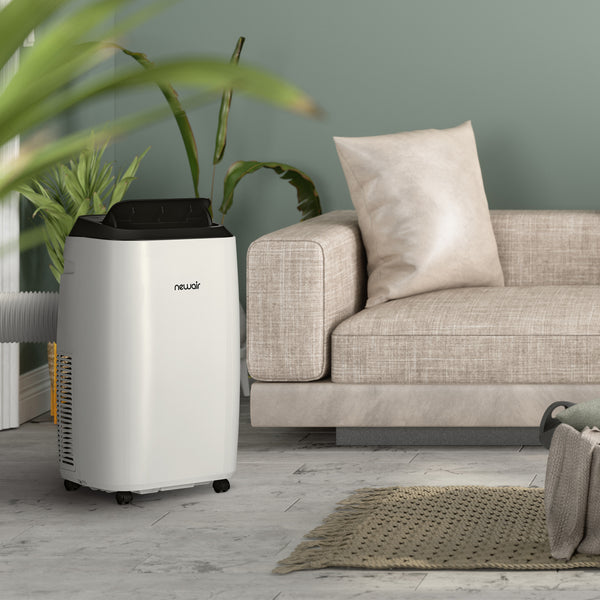
When we first saw the ACP-1300H, we were impressed by its size and style. Although it weighed roughly 88 pounds or so, the inclusion of large, easy-to-roll casters allowed us to move the unit from the living room of our apartment to the bedroom and back. The all-white finish on the ACP-1300H was clean and sleek, while the elongated body style was perfect for corner placement. For effortless operation, the NewAir ACP-1300H featured a clear VFD display screen which also illuminated in the dark. A remote control let us operate the AC from across the room, while the standard household outlet did not require us to perform any additional electrical work. In fact, we were able to get the ACP-1300H up and running in just minutes.

Cooling Abilities and Condensate Removal:
As stated above, a portable AC’s BTU rating is one of the most things to look for. As such, we were assured by NewAir that the ACP-1300H offered 13,000 BTUs of cooling, and this was true. In fact, even on low speed, it did a great job of cooling our 400 square foot living room. Furthermore, the ACP-1300H utilized evaporative technology. This meant that the unit sent all the condensate out of the window in the main exhaust hose so we didn’t have to empty a separate water contain cup. Moreover, the ACP-1300H also functioned as dehumidifier (up to 120 pints per day).

Multi-Functional:
The NewAir ACP-1300H portable air conditioner could do more than just cool. In fact, it even had a powerful built-in 13,000 BTU space heater for use during the colder months. Best of all, this portable AC also featured an ionizer to remove harmful particles such as dust and dander, as well as an activated carbon filter to keep the air fresh from odors.

Overall, we really liked the NewAir ACP-1300H and the features it had to offer. At less than $500, we also felt this portable air conditioner was a great value.

Labels:


Digg Del.icio.us Technorati
Furl Reddit Spurl